Recycling & Sustainability for Landscape Gardening Gardeners
 Landscape Gardening Gardeners today are more than green-fingered designers — we are resource managers and circular-economy advocates. Our sustainability page explains practical steps our landscape gardeners take to reduce waste, partner with local services and charities, and run a low-carbon fleet. We set a clear recycling percentage target and measure progress annually so every client knows our environmental commitments. We believe thoughtful garden care should leave a lighter footprint on the boroughs we serve.
As a team of landscape gardening services and gardening contractors, we work within local authority frameworks and adapt to boroughs' approaches to waste separation. Many local boroughs operate a three-stream system — garden waste, food waste and dry recycling — so we train crews to sort material on site, maximising reuse and preventing contamination. On-site segregation is the first step in improving recycling outcomes and keeping compost streams clean for community composting projects.
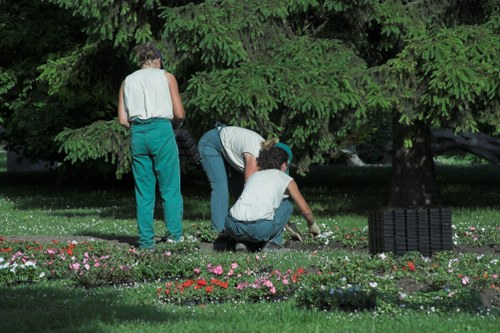 To make our goals concrete we have adopted a recycling percentage target: a company-wide aim to divert 80% of all non-soil waste from landfill by 2028, and to increase organic reuse so that at least 65% of green waste is reprocessed locally into compost or mulch within three years. This target covers clippings, prunings, turf, timber offcuts and packaging from supplies, and is reviewed quarterly to track improvements and identify where additional training or equipment is needed.
Local Transfer Stations and Responsible Routing
We coordinate collections with permitted local transfer stations and recycling centres: for example, the City Borough Transfer Station, Riverbend Transfer Station and the Northside Reuse Hub. These facilities handle separated green waste, timber for chipping, inert soils and recyclable plastics. By choosing transfer stations that prioritise local processing we reduce haul distances and support borough-level recycling targets. Our routing software prioritises the closest compliant site, cutting mileage and emissions while ensuring materials are accepted into the right recovery stream.
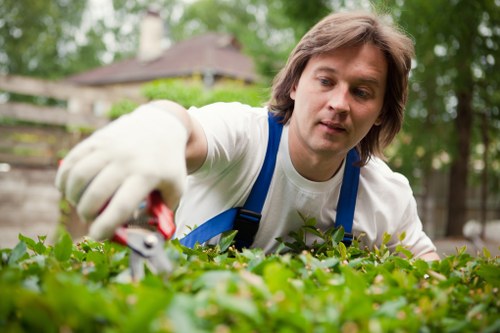 Landscape gardeners frequently encounter mixed loads; by pre-sorting at site we avoid cross-contamination and enable higher-quality outputs like screened compost and reclaimed timber. We also use designated skips for inert materials, topsoil, and recycled aggregate so construction-phase landscaping waste is recycled back into projects where safe and appropriate. This approach keeps usable materials in circulation and reduces the need for virgin aggregates.
We maintain clear record-keeping for every job: weighbridge tickets, transfer notes and recovery certificates when applicable. These records support our annual sustainability report and validate our recycling rate against the stated 80% diversion goal. Our transparency helps clients and regulators understand the environmental performance of garden maintenance and landscape construction activities without exposing confidential information.
Partnerships with Charities and Community Reuse
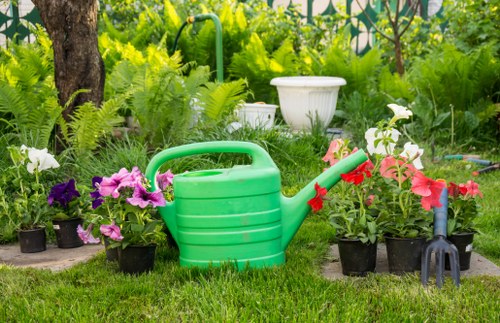 Partnerships are central to our reuse strategy. We work with local community gardens, horticultural charities and social enterprises to donate reusable items: intact paving, planters, timber sleepers and surplus topsoil. These alliances support community greening projects, allotments and educational horticulture programmes while keeping fit materials in use. Rather than sending serviceable goods to processing, we deliver them to charity-led projects that extend the lifespan of materials and benefit residents.
Our donation pathways prioritise charities and social enterprises that have the capacity to reuse materials responsibly. Typical routes include:
- Community garden networks that need soil and planters,
- Local reuse charities that accept timber, tools and salvageable landscaping materials,
- Social enterprises that transform green waste into compost for neighbourhood planting schemes.
 A further element of our sustainability programme is the transition to a low-emission fleet. We operate a mix of fully electric vans for smaller service rounds and plug-in hybrid or Euro 6 low-emission vehicles for larger loads that still require diesel. Our logistics planning aims to replace diesel-only vans with electric or low-carbon alternatives so that by 2030 the majority of routine visits will be carried out by zero-emission vehicles. This reduces scope 1 emissions from the gardeners’ operations and complements the emissions reductions achieved by local processing of green waste.
Beyond vehicles and reuse, we invest in equipment and training: battery-powered tools, mulchers that produce on-site mulch for reuse, and crew training in best-practice waste separation. These investments lower noise, eliminate small-engine emissions on projects and increase the proportion of material we can directly recycle into the landscape we maintain. Practical changes on site deliver measurable carbon and waste savings.
We also monitor borough-specific requirements — for instance, where a borough has dedicated brown-bin garden collections or requires certain materials to be brought to transfer stations — and adapt our processes accordingly. By aligning operations with local waste collection schemes we improve recycling outcomes for residents and simplify regulatory compliance for larger landscaping contracts.
In summary, our approach as landscape gardening professionals blends an ambitious recycling percentage target with practical partnerships, local transfer station coordination, and a transition to low-carbon vans. These measures ensure that our landscape gardening and grounds maintenance activities support circular reuse, reduce emissions and deliver resilient, greener neighbourhoods.